
The Day I Shed Blood for My Country
By JAMES OTT
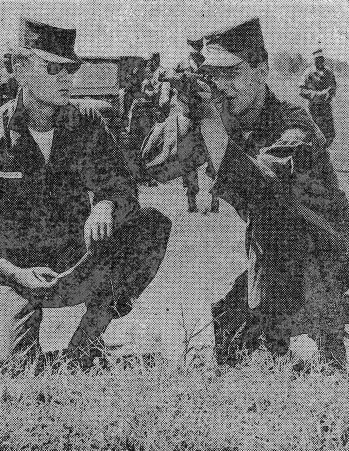 More than a half-century has passed since the day I agonized in an Army Medical Corps ambulance while a medic attended to me.
It was hot and breezy. The ambulance was parked in a field of tall and dry yellow grass and weeds. In a training exercise, infantrymen were passing into thick woods nearby and the thump of artillery and the occasional crack and air-piercing screech of rifle fire filled the air. My suffering that day served as a high point of my ordinary Army career.
I think of this experience every Veteran’s Day especially when my grandchildren and their classmates pin hand-drawn medals on me at school celebrations. Honestly, I’ve always felt a little out of place as a Cold War reservist next to former soldiers, sailors, marines, coasties and airmen who actually fought enemies and won medals.
But, then, I know that we all had varied experiences in the military. When I served, it was a period of uneasy peace, a time like no other. Our country had not declared war, yet there were plenty of signs of it. Army troops faced East German and Soviet Russian soldiers on the Iron Curtain border at Berlin’s Checkpoint Charlie. The U.S. and the Soviets played a dangerous kind of chess, vying for advantages that would lead to the Russians installing missiles in Cuba, setting off a world crisis. Tensions were high in Korea and on Taiwan as soldiers faced each other over battle-scarred zones and heavily bombarded islands in the Formosa Strait known as Quemoy and Matsu. High-tech intelligence games were being played in air space and on oceans everywhere. Threat of nuclear annihilation loaded heaven-knows-what into our Cold War psyches.
In that ambulance at Camp Breckinridge, near Owensboro, Kentucky, the world in conflict took on a personal note. I remember how I felt that day and the months following. It was no joke standing there bleeding and dazed and in need of medical help.
The story unfolds with my enlistment at Ft. Thomas, then an induction center, home to several Army Reserve units and a Veterans Administration hospital. A year of classes in a Reserve Officers Training Corps (ROTC) program had given me a head start in the military, and I completed basic training at Breckinridge, assuming the rank of private first class. Several months later, I was attending my first summer camp as part of a communications team with the 375th Field Artillery Battalion of the 100th Infantry Division. We packed our gear in a trailer, hooked it up to a Jeep, and drove into Breckinridge’s wild interior. The 105-millimeter howitzers of A Battery were pounding the daylights out of some distant target. We had to set up a field telephone system between fire direction center (FDC) and A, B and C batteries. For some reason the batteries were widely separated, and we had to connect them all by telephone. We gathered around a sergeant who sat in the Jeep, happy that his rank had exempted him from the ghastly detail that lay ahead. He had placed, behind him in the trailer, a huge reel of thin telephone cable. When the Jeep moved out, the wire began to unwind as another poor soul and I tracked behind at a trot, anchoring the line to trees and poles.
The Jeep traveled 13 miles that day—with us behind it—to hook up the telephone system. Kentucky clay dirt roads had pulverized into face powder, which rose from behind the Jeep’s wheels like a storm out of Lawrence of Arabia. At day’s end when I looked into the rear view mirror I saw two brown eyes and a face and hair in pancake makeup. But the mission was accomplished. The 105s were barking, keeping everyone for 20 miles around nervous and wide awake.
Soon enough, the artillery batteries ran short of ammunition. They turned to the communications team for some muscle to re-supply the batteries. Another sergeant headed the detail. He got behind the wheel of a 2.5-ton truck, known as a Deuce and a Half, and drove to the ammo dump. Once inside the gates, the sergeant stood by and counted the heavy wooden crates marked for 105s that we hauled from their secure storage inside earthen mounds. The truck filled up fast. One of the more alert guys questioned whether the load was getting too much for the truck.
“Don’t worry about it,” the sergeant said.
We continued loading the crates until the truck was packed to the canvas top, leaving scant space for riders. The truck strained and lurched. About a mile out, a huge blast thundered beneath us. A tire had blown. Fortunately, the sergeant had a radio and called the motor pool for help. During the wait we unloaded the boxes. A motor pool truck responded and replaced the tire, and there was hardly any cussing. We started re-loading the ammo boxes, complaining that, hey, if the load blew a tire, maybe there is just too much weight.
“Just do it,” the sergeant said.
The truck engine strained against the load. I thought for a while that, well, maybe the sergeant is right. It was a new tire. Just then, an explosion beneath us from a blown tire marred what was left to the peace of that afternoon. The sergeant radioed for help a second time. A clearly irritated soldier from the motor pool arrived and had a few harsh words with him. This time, there was some cussing. We unloaded the ammo boxes again and, after a new tire was bolted on, we reloaded them, only leaving some boxes on the roadside under guard. The truck, considerably lighter, made its careful way to the batteries.
Back at headquarters, a rumor had spread that the mathematical geniuses in fire direction center had made a critical error in calculations. A battery had laid down a barrage of screaming 105-millimeter shells into a civilian cemetery. We knew the rumor was true. A delegation of irate local citizens swarmed into the office of the post commander. The 375th had made some genuine enemies among the civilian population that day. In the process, our unit, nicknamed Van Veen’s Virgins after the commanding officer, gained a new reputation, not as a killing machine in defense of the country, but for wasting the already dead among our own people.
After several days the unit moved from the barracks into the field. We set up two-man pup tents and dutifully dug drainage ditches around them, and packed the tents with air mattresses and gear. Word got out that we were to be treated to outdoor bathing. A portable shower system was installed in a large tent, fed by water from a lake near a country road. A thousand guys standing nude and carrying towels lined up in front of that tent.
Just then, in a case of perfect timing, a convertible full of young girls drove down the road, waving and laughing. We sent up a cheer, the like of which I have never heard before or since. It was an odd feeling that, for once, we were the objects of fascination and interest from the opposite sex. Instead of a few men admiring a long chorus line of beauties, we in our great numbers were seen au naturel by a few who thought it hilarious.
Emerging clean from the shower bath and returning to the bivouac area, my tent buddy and I fell onto our air mattresses and soon were asleep. The air squished and squashed around in the mattress with every move, but I was mostly unconscious until very early the next morning. I began to itch around my middle and around my ankles and in very private areas. Oh! How that itch made life miserable. I scratched and scratched. My tent partner was scratching too. Soon, it seemed, hundreds of red lumps appeared in all of those itchy places.
We reported our dilemma to the top-kick sergeant.
“You got chigger bites,” he said.
He dispatched us to the ambulance on that dry field where we could hear the batteries opening up, hopefully on the target this time, and a company of infantry moving ahead in ragged formation. By then, my incessant scratching had enflamed the red lumps and many were bleeding, not profusely. But it was, after all, my blood being spilled. A medic painted what looked like fingernail polish on each one. It felt so good! He counted 148 bumps in all of those peculiar places. My buddy had 135, and an unfortunate major from some other unit broke the record for chigger bites that day with 154. He was six points more miserable.
Application of the cold ointment helped a lot. Around my hands, though, red bumps just wouldn’t go away. Even months later, after my return to college, the itch from a few bites was so intense that I’d scratch, drawing a little blood. The sores eventually faded away, much like my career in the reserves. Vietnam was heating up. During a summer camp at Ft. Sill, Okla., a wrinkled old sergeant presciently observed that it was “the next place.” And the world changed again and again and again.
For me, a miserable casualty of the Cold War, there was no Purple Heart. General Washington, who initiated this great honor for deserving wounded soldiers, wouldn’t approve, I’m sure. Each Veteran’s Day recognizes the great contributions of men and women toward maintaining freedom and the cause of liberty here and around the world. I accept paper medals from my grandchildren for the very small part I played and for which I have fond memories of military life long ago.
James Ott is a retired senior editor at Aviation Week & Space Technology. He served with the Army Reserve assigned to Headquarters Battery, 375th Field Artillery Battalion, 100th Infantry Division, at Fort Thomas, Kentucky, and with the 2075th USAR School. He lives in Crescent Springs, Ky.
 Ramblings on Aviation, Art and Literature