
Fine artists in Cincinnati often speak of Frank Duveneck’s ability to express form in three dimensional planes. Carl Samson tells the story in the Foreward to The Greatest Brush, my Duveneck biography, of how he correctly answered his mentor, R.H. Ives Gammell, when he was asked, “What three painters relied mostly on an understanding of three dimensional planes to express form?” Franz Hals was one, John Singer Sargent another, and our Frank Duveneck.
I was reminded of this exchange today while reading the Magnificat, the monthly worship aid magazine, which publishes stunning artistic images and provides descriptive articles. This month’s issue offers the painting, The Sermon of Albertus Magnus (Friedrich Walther, 1440-1494)) which is in the Cloisters Collection in New York City. The painting was completed when art was catching up with science. “Perspective offered painters the ability to create three-dimensional images on two-dimensional surfaces, and oil painting, a 14th century German development, allowed painters more time and versatility to re-create in art the world around them in meticulous detail.”
Walther, typical of his time in Bavaria, had less concern for accurate representation of the body. Albert the Great is portrayed as a huge figure instructing a diverse cast including a cardinal, a knight and a friar. Walther’s work was completed about the same time that Leonardo da Vinci produced the Virgin of the Rocks in Milan.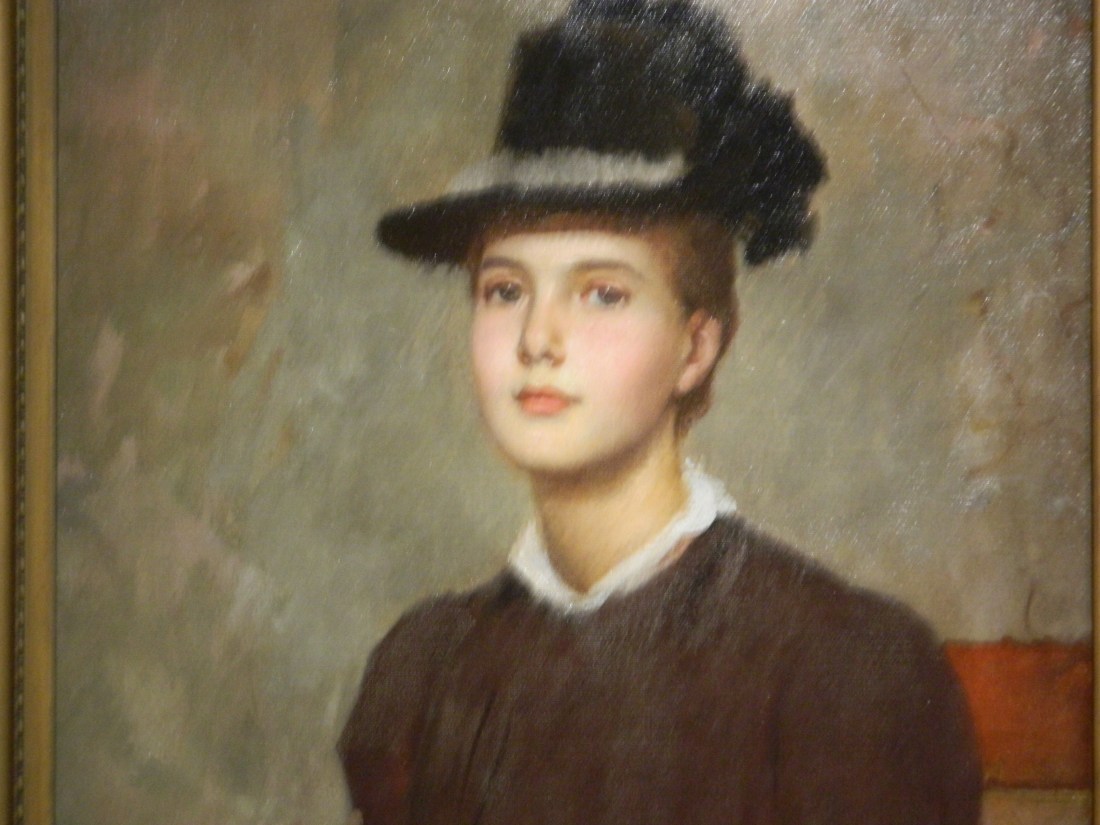
Duveneck’s 1890 rendition of Marie Danforth Page of Boston
 Ramblings on Aviation, Art and Literature