
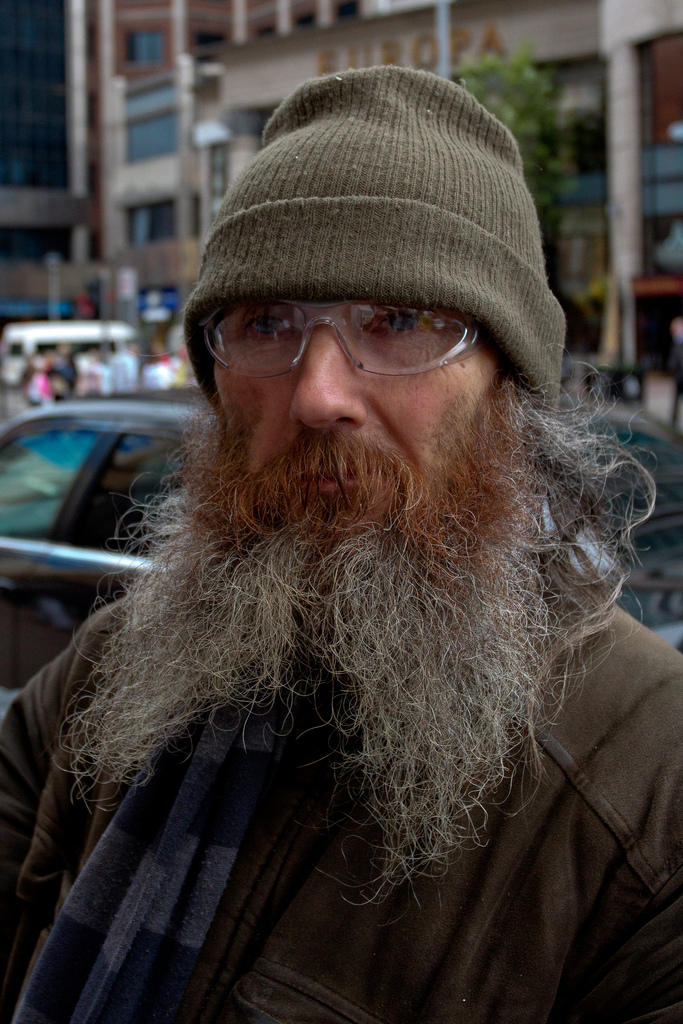
The people in this article will never read what is said about them. They only see newspapers on corner racks or hear headlines blared by some newsboy.
These people are the unwanted, misfits of society who roam the streets by day and sometimes by night. You can see them shuffling along ahead of you on the streets. They are ragged, dirty and unshaven–the lonely faces in the crowd.
Often you wonder, perhaps, where they stay at night.
The jail at City Hall is open to them. At least five or ten a night sleep on park-type benches or on the floor inside the locked doors. This is the summer group; there’s more in the winter when the nights are cold.
The jail’s not much, but it’s home to them.
A few years ago there was a man who virtually made the jail his home. He stayed there almost every night for three years. He was old, crippled and senile.
As a man, police said, he was kind and very reticent. But he had one salient failing. He never bathed. One night a police officer, who could not take the odor anymore, took him aside and told him he must take a bath. The officer escorted the old man to the shower room and saw to it.
The fellow never came back after that night.
The lodgers at the jail come from all over the country: Texas, Georgia, New York, California. Some are transients and they’re, of course, always heading for a job somewhere. These are the ones who have some spirit and pride.
A typical conversation with one of these men is this:
-Where are you from?
-Texas.
-Where are you gong?
-North, to get a job.
-A Texas wrangler, huh?
-Yeh.
He smiles with obvious pride.
Jailers started allowing a few vagrants into the jail in the 1940s. Small missions used to keep them in ‘flophouses” before that, but now their doors are closed to them too. The police do not know of one ‘flophouse’ in the city.
There is one requirement to get in: Name and hometown. The return is a roof overhead. Generally that is all. Sometimes there’s food, what’s left over from the prisoners. But that’s not regular.
The food at the jail is not what you would call rib-sticking. Coffee and bologna sandwiches–one each at lunch and supper–and a hard sweet roll at breakfast.,
The lodgers begin to trickle in about 9 p.m. and some stroll in as late as 2:30 a.m. But they all must leave by 5:45 a.m.
As a general rule, the lodgers are quiet, like the old man who never bathed. They seldom say anything other than, “Can I stay for the night?” Still more seldom do they cause any trouble. When they do, they must be thrown out, and obviously they don’t want that.
One veteran police officer described them like this: “They all seem beaten. They have no interests in life and live only from day to day. They are usually old and either physically or mentally handicapped. And they have nowhere else to go.”
A cursory glance at the lodgers’ record book shows one facet about them which repeats itself day in and day out. They are all Anglo-Saxons, at least by the names given, even among those who are just passing through.
They are Browns, Smiths, Williams, Jones, Burtons, Williamsons. But last week a “John Milton” from Tennessee registered for the night.
Lodgers range in height from tall to short, but police who have been watching them for years say you never see a fat one.
—written by the author more than fifty years ago during a year’s duty as a police reporter on assignment at Central Station in Cincinnati City Hall. The article was published in The Cincinnati Enquirer, which proudly accepted the Pulitzer Prize recently for local reporting.
 Ramblings on Aviation, Art and Literature