Ord sharpened marksmanship skills of regular Army soldiers at trendy new Fort Thomas and led the charge on Cuba’s San Juan Hill
By JAMES OTT
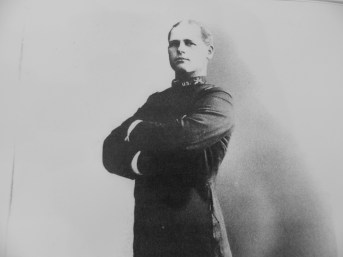 Smart and polished in his blue uniform, Second lieutenant Jules Garesche Ord, son of a Civil War Union general, reported for duty in summer of 1897 at the newly constructed Army post of Fort Thomas, Kentucky. He was assigned to the fort overlooking the Ohio River to join the famed Sixth Infantry Regiment, one of the original six founding units of the Army that served with distinction in battles dating to the War of 1812.
Even as war drums sounded in America’s sharply competitive Yellow Press of the day— mindlessly antagonistic to Spain—Ord could not possibly have conceived that before the year was out he would lead a famous charge during the Spanish-American War to capture San Juan Hill near Santiago, Cuba. For this heroic act, one of many in the campaign to free the island from Old World domination, he would win fleeting fame and no medals.
Lean, athletic and handsome, Ord struck a fine figure of a man. Known as Garry, he was a rising star in the Army. Fellow officers knew of him for the battlefield successes of his father, Edward Otho Cresap Ord, commander of Union forces at the 1863 victory at Vicksburg. The army honored his wartime achievements by naming Fort Ord in California after him. Garry was the youngest of seven offspring of General Ord and the beautiful Mary Mercer Thompson. Two of Garry’s brothers served in the Army.
A newspaper described the young officer as “a man of splendid physique and of such a frank and manly disposition that everyone was instinctively attracted to him.” Enlisted men of the Sixth regarded him as tried and true. Not a West Point graduate who built a career on his father’s reputation, Ord had enlisted as a private under an assumed name, Garry Ordish, in 1887 and rose through the ranks to quartermaster sergeant. In 1890 he received his commission as a second lieutenant.
Within a month of his arrival at Fort Thomas, Ord was promoted to first lieutenant and turned thirty-one years old on September 9. His first assignment was to serve as range master at the Sixth’s two firing ranges, one within the 111-acre fort and a second on a flat piece of land among rolling hills located approximately a dozen miles to the west along the Licking River. The U.S. government in May of 1891 had acquired 569 acres for the range in the “Scotchman’s Bottom,” paying William Taliaferro $11,750. The Tri-City Sportsman Club occupies the land today on Rifle Range Road in Alexandria, Kentucky. Earthen berms constructed to absorb spent bullets are still obvious there. Nature and time have rounded off the edges of a trench and crumbled a bank of concrete bunkers, further masked by brush and bramble and layers of leaves. In the protected trench soldiers sent up and pulled down targets and waved the red flag, “Maggie’s Drawers,” when a soldier had a total miss.
For decades civilians watched soldiers as they marched to Alexandria Pike (US 27) and shambled down narrow roads to the firing range.
As range master Ord was overseeing the Sixth’s soldiers armed with the standard issue Krag-Jorgensen, a .30-caliber repeating bolt-action rifle. It featured a side load magazine for five cartridges and fired smokeless powder rounds. Sharpening of troopers’ shooting skills would come in handy the next year, 1898, and leadership from men like Ord would be critically important. As always, the Army would depend on natural-born fighters to lead men into battle. By blood, character and personal drive, Ord embodied that caliber of man.
As he strode through Fort Thomas’s gates he doubtlessly recognized the Army-style dark red-brick structures that lined roadways and circles. Gracious and modern for their time, supplied with indoor plumbing, the buildings eventually numbered forty nine and their uses further defined the Sixth as a self-contained unit. In addition to regimental headquarters and four large brick barracks, fronted by wooden porches, the Drill Hill contained a canteen, bowling alleys and shops for barbers and tailors. Other marks of an intact organization extended to a 100,000-gallon water tower, enclosed in a stone, crenellated tower (a logo for the City of Fort Thomas, still standing); a commissary that served families with fresh meat and foodstuffs, staffed by a cadre of bakers and a detail of carpenters; a chapel and a hospital. A corral and stables provided for horses used for riding and wagon-pulling duty. The Army estimated initial construction costs at $3.5 million dollars, not counting construction of the Drill Hall, stables and barracks.
To maintain good public relations with the community, the Sixth fielded a band and opened the fort’s gates for Sunday afternoon concerts and ceremonial parades. Boxing matches were another draw and the Sixth’s highly touted baseball team recruited some talented local residents.
Regimental headquarters, six companies of infantry and support units brought the roster to more than six hundred men. Troopers dressed in Class-A Army blues were everywhere in those days attending public events and social affairs. “There are indications on every hand of the friendships formed with the civilians near the post and the high regard in which all the military organizations have been held,” according to a brief history of the fort prepared by the Army’s Center of Military History prior to World War II. The Army’s presence meant a boost for business in the community of Fort Thomas.
Soldiers performed garrison duties in and around the fort, wearing fatigue uniforms and wide-brimmed campaign hats. They maintained buildings, their architectural style frequently referred to as “quartermaster gothic.” They kept unit equipment in good condition. In this comparatively peacetime era of 1897, men took classes of various kinds and trained for battle. As infantrymen, the men of the Sixth endured lengthy forced marches. In the same period that Ord reported for duty the regiment marched one hundred and twenty-six miles to Columbus, Ohio, and participated in a parade honoring the Grand Army of the Republic.
Ord doubtless was proud to be a member of the Sixth, the first unit to be assigned to Fort Thomas. The fort was named after Union General George Thomas, the Rock of Chickamauga. The cavalryman General Philip Sheridan, then chief of staff, had chosen the highlands site. Standing at an observation point above the Ohio River he found a comparison to Trophy Point at the U.S. Military Academy and the Hudson River in New York, persuading him to christen the new fort the West Point of the West. Construction of the facility began in 1888 and was nearing completion of the first phase when two companies of the regiment took up tenancy in 1890.
Fort Thomas replaced the flood-vulnerable Newport Barracks along the Ohio River as the region’s primary Army facility. The hilltop fort benefitted from ample congressional funding, supported by Sheridan, who had foreseen the need for permanent posts on the frontier after Custer’s massacre at the Little Big Horn in 1876. A far cry from the scattered ramshackle accommodations of post-revolution America, Fort Thomas served as a showplace. Almost glamorous in comparison to earlier facilities, the modern and self-sufficient fort represented an industrial nation on the brink of becoming a world power.
For the young officer and all of America 1898 was a transitional year in the country’s history. The U.S. was a haven for freedom-loving people of the world; population in 1898 topped 75 million. Growing industry and new products boosted national wealth to $65 billion, which exceeded that of Britain, Germany and Russia combined. Moreover, many in official positions in government and business foresaw a need for the young nation to extend its influence for the purposes of trade.
Chief among these theorists were the historian Frederick Jackson Turner and the naval historian Alfred Thayer Mahan. They deduced from an analysis of the muscular drive and spirit of the nation that it was standing in the wings of becoming a leading nation. Mahan authored The Influence of Sea Power Upon History, which made a case that the U.S. fleet should grow in tandem with the rise of the nation’s industrial might. As the modern navy deployed ships across the seven seas, he argued, trade would follow and national security would improve.
Mahan strongly influenced Theodore (Teddy) Roosevelt, the assistant secretary of the Navy in the administration of U.S. president William McKinley. Roosevelt is reported to have read Mahan’s book over a weekend. Other notable figures in the Mahan camp included the influential Connecticut lawmaker Senator Henry Cabot Lodge and Kaiser Wilhelm of Germany. In consequence Germany was among nations that engaged in an arms race and expanded naval fleets in emulation of the seafaring power of Great Britain.
While the United States was on the rise, the once great empire of Spain was fading. Like most countries in Europe in the middle of the nineteenth century, it had been rocked by revolution. In 1876 the monarchy was restored with the enthronement of King Alfonso XII of the Bourbon dynasty. He died in 1885 at the age of twenty-seven. In his stead Maria Christina of the Hapsburg Austro-Hungarian Empire, enceinte with his heir, reigned as regent in place of their son, Alfonso XIII, the successor crowned at birth. The royal house’s hold on the beleaguered nation was tenuous, threatened by a rival claimant for the throne, Don Carlos, who even in exile had substantial domestic support.
Spain’s government affairs on the administrative level were equally precarious. The premier, Antonio Canovas del Castillo, a key figure in the restoration of the Bourbon monarchy, was assassinated about the same time Ord reported at Fort Thomas, August, 1897. Praxedas Mateo Sagasta, a moderate politician keen on reform, replaced the dead premier. Threats of civil strife and financial ruin weakened the nation and rebellion was troubling both Cuba and the Philippines, its major colonies on opposite sides of the world.
A colony of Spain since its discovery by Christopher Columbus, Cuba for generations had been in the sights of some American leaders. Antebellum southerners deemed the island a potential annex for an extension of slavery. The Civil War ended that presumption. The U.S. government maintained an interest in Cuban governance, rooting its foreign policy posture on the Monroe Doctrine designed to protect republics in Latin America from Old World domination. When Cuban rebels rioted in Havana early in 1898, the U.S. dispatched the USS Maine, one of its newer cruisers, to the port to protect U.S. interests. The Spanish regarded the visit as a bold intrusion in domestic affairs.
The insurgency in Cuba against the mother country, which started in 1895, had been a continuing story across the world. In the U.S. Yellow Press, newspapers depicted Spain’s harsh crackdown with big headline outrage. Respectable journals provided convincing accounts of atrocities at the hands of the “Dons.” In this heyday of print journalism, the press strongly influenced American public opinion. Journalists provided details of a controversial “reconcentrados” program that herded Cubans, young and old, into notoriously inadequate camps. Another policy imposed “trochas” on the island, which set up 200-yard wide belts of no man’s lands from one side of the island to the other.
These severe measures, introduced by Prime Minister Canovas del Castillo, were implemented by General Valeriano Weyler y Nicolau, the appointed Cuban governor who became a depraved symbol of the repression. In the wake of the Canovas’s assassination in Spain, his successor Mateo Sagasta recalled General Weyler and introduced reforms. But the damage had been done. The U.S. and its people were convinced that gross mismanagement was depriving Cubans of their right to freedom. And, further, they were starving and needed help.
The powder keg that was Cuba needed a fuse and trigger. A spark was found in the explosion and fire February 15, 1898, that sent the USS Maine to the bottom of Havana Harbor and killed nearly three-quarters of the crew. A Naval Court of Inquiry concluded the crew was not at fault. The probable cause was given as the detonation of a submarine mine, which set off explosives in two or more forward magazines. The report did not name a perpetrator. Separately—and ignored by the press—Spain’s investigation suggested a spontaneous combustion of coal had touched off the Maine’s magazines. The true cause remains a mystery. Later investigations have tended to side with Spain. Physical evidence pointed to an explosion within the ship.
In subsequent bilateral negotiations with Spain, the U.S. demanded independence for Cuba. Americans took to the streets, proclaiming, “Remember the Maine! To Hell with Spain!” Under pressures to do something Congress declared the U.S. had no interest in gaining control of Cuba then legislated for intervention only for the purpose of bringing peace to the beleaguered island. Congress’s war-for-peace action was taken on April 19. On that very day, Ord and the Sixth, obviously having been on alert, marched through Cincinnati and crossed the Ohio River via the Central Bridge to Newport. Troopers were met at York Street with banners and a large crowd. Most signs read: “Remember the Maine.” From the top of a York Street residence, “Butcher” Weyler was hanged in effigy. Inscriptions declared, “Death to the Spaniards” and “Cuba Libre.” It was a gala occasion.
“Every house in the city was decorated, even the humble cottage, had the Stars and Stripes and gay colored bunting on the outer walls,” the Cincinnati Enquirer wrote. “Up York street the procession passed in review of the thousand or more school children with little brothers and sisters, all of whom had been given reserved positions along the street. Each child, equipped with a small flag, waved the colors and cheered for the ‘Sixth.’ Their bright little faces had a visible effect upon the rough countenances of the bearded soldiers, and despite their knowledge of marching orders, hundreds of hundreds of times the soldiers would dash from the line, pick up little girls or boys and embrace them, and with tear-stained face move on.”
Members of the Newport Fire Department led the procession, clearing the way “of the surging mass of humanity.” Newport police officers under Chief Bennett and the First Regiment band followed behind. City officials and dignitaries preceded the Chamber of Commerce band and the Sixth’s own band, the long line of the soldiers in blue marching in “as patriotic a spectacle as ever passed through Newport’s streets.”
The soldiers paraded in Newport for an hour before assembling at the railroad station at the head of Monmouth Street. Brewer George Wiedemann provided liquid refreshments and ham and cheese sandwiches for the soldiers. In a foretaste of the logistical mess that was to come at the launching port at Tampa, Florida, the Sixth moved in three train sections. The first, consisting of two flat cars, two box cars, two cars containing horses and a baggage car, pulled out at 8 p.m. A second section followed five minutes later consisting of two baggage cars. The final section moved out at 8:30 p.m. containing nine sleeper cars and two carrying baggage. The train made it across the Licking River to Latonia and halted for repairs to one of the first section cars. Next stop was at Corinth, Kentucky, where two of the heavier sections were provided with two engines each. When the trains reached Florida on April 21, a fire from an engine spark broke out in one of the cars destroying hospital supplies, rations and tents and personal belongings of several officers.
Trains converging on Tampa created a massive traffic snarl. The city was served by two single-track rail lines, owned by separate railroad companies, and one nine-mile track to Port Tampa and a single wharf. Freight cars jammed railroad sidings for fifty miles. Even into June, freight cars were being held as far away as Charleston, South Carolina. Further, no baggage cars had been marked for contents, which resulted in mass confusion as solders sorted through personal baggage to locate weapons, ammunition, rations and the like. Troopers loitered in camps around Tampa awaiting orders as the weeks passed into May and then June. Loading of ships moved at a snail’s pace in the Florida heat, and the government grew more impatient by the day.
The Navy contributed to the snafu by assigning fewer ships than were required to move the 25,000 troops in the Tampa area. Lack of space forced Army leadership to make hard decisions. Cavalry units were ordered to operate as ground troops and leave their mounts in the U.S. Only officers were permitted to ferry horses for personal use.
High-ranking Washington officials sent a string of telegrams to Army commander Major General William Rufus Shafter on June 7, demanding that the invasion force get under way. Shafter, a Congressional Medal of Honor winner from the Civil War, responded with a preemptory order for troops to begin boarding transports immediately, or be left in camp. He informed Washington that the invasion force of 834 officers and 16,154 men would be ready by dawn the next day. All through the night soldiers spilled into the waiting ships. The Sixth boarded the Miami, one of thirty-two transports.
In a classic case of hurry-up-and-wait, the ships sailed to the middle of Tampa Bay where they lay at anchor in the sweltering heat for a week. The postponement was necessary for the Navy to scour the ocean lanes and make certain that a Spanish fleet, rumored to be operating in the region, would not attack the vulnerable invasion force. The final order to embark came a week later, June 14. Six days later the invasion force with fourteen escorting warships arrived off the port of Santiago. Early on June 22 the soldiers, bearing their haversacks and horse-collar bed rolls, loaded into small boats towed by steam launches. The boats landed at the village of Daiquiri in high winds and heavy surf. In the following days landings continued at a more weather-clement site at Siboney. Troopers of the Sixth landed on June 23.
The invading force faced little resistance from the 196,000 Spanish soldiers garrisoning the island. Weather continued foul. Torrential rains swept the camps and mosquitos pestered the Americans. Large-size land crabs harassed troopers and scrambled through the tropical bush, impersonating probing enemy scouts to wary soldiers standing guard.
Ord was temporarily attached as an aide to Brigadier General Hamilton Hawkins, commander of both the Sixth and the Sixteenth Infantry. The regiments were key to a broad attack plan involving 8,000 U.S. troops, a total of thirteen Regular Army regiments, including four Black units, the Rough Riders of Teddy Roosevelt, and another regiment of volunteers equipped, as most volunteers were, with the single-shot, breech-loading, trap door Springfield rifles. Early on July 1 General Shafter split his force, starting with an attack on the village of El Caney. The Sixth and the Sixteenth moved along a narrow road to positions at the base of San Juan Heights, which consisted of Kettle Hill, so named for the iron pot used for sugar refining, and San Juan Hill and its blockhouse, the other objectives of the day. Hilltop defenders, armed with the magazine-fed, 7mm Mauser bolt-action rifles that fired smokeless rounds, leveled deadly fusillades on the troops below. The Sixth lost a quarter of its men inside of ten minutes and suffered the highest casualty rate of any unit on July 1.
The Army’s campaign was inconveniently short of artillery. Shafter had declined Navy offers of gunnery support. Sixty artillery pieces remained in Tampa due to the lack of cargo space in the invasion transports. Siege guns were shipped but fears that muddy ground would immobilize them left the heavy weapons in cargo holds. Old-style cannons assigned to the attacks employed guesswork in targeting and used smoke-producing black powder. A battery of light field pieces bombarded enemy lines before each attack. But the hand-cranked, six-barrel Gatling machine guns and heavy doses of courage are generally credited with the role of critical factors in the battle.
As the Americans lay under intense and accurate fire from Spanish snipers, line officers clamored for an order to attack. Retreat was unthinkable. Withdrawal would expose troops and result in more losses, and it was thought suicidal to remain in position. In that pressure cooker Shafter’s aide at the front, Lieutenant John Miley, gave the order to attack the hilltops. The question left to the line officers was: How? Hawkins, in command of the two regiments, hesitated to order an uphill charge under deadly fire. Then, Ord spoke up to Hawkins.
“General, if you will order the charge, I will lead it.”
Just then, the Gatling guns opened up at 400 rounds per minute, raking the hilltop positions.
“We can’t stay here, can we?” he pleaded. “I only ask you, General, not to refuse permission.”
“I will not ask for volunteers,” Hawkins said. “I will not give permission and I will not refuse it. God bless you and good luck.”
Ord, according to one account, ripped off his shirt, picked up a saber and a pistol, shouting, “Come on—come on, you fellows! Come on—we can’t stop here.”
At the start of the charge Journalist Richard Harding Davis observed that “there were so few. It seemed as if someone had made an awful and terrible mistake. One’s instinct was to call to them to come back. You felt that someone had blundered and that those few men were blindly following out some madman’s mad order. It was not heroic then, it seemed merely terribly pathetic. The pity of it, the folly of such a sacrifice was what held you.”
Soldiers in blue stood out climbing and moving up the green hillside. A military attache observed the movement and commented to Stephen Crane, author of The Red Badge of Courage, “Why…They’re trying to take the position.”
About this same time Colonel Teddy Roosevelt was ordered to charge Kettle Hill. His men on foot behind him, he aboard his horse, Little Texas, the future president charged up the hill, dismounting only when he encountered a fence. To the left of the Rough Riders, Buffalo soldiers of the Black Ninth and Tenth Cavalry climbed the hill, firing away. Reaching the top Roosevelt confronted a Spanish officer and killed him with a single shot of his revolver.
Roosevelt ordered his men to lay down supporting fire on San Juan Hill while Ord and the few closed in. At this point many defenders had retreated down the opposite side of the hill. On top Ord leapt a trench and halted to offer aid to a Spanish soldier. The soldier repaid him by firing a mortally wounding shot into his neck. A soldier of the Sixteenth, Clifton M. Spears, of Lexington, Kentucky, who had followed Ord, promptly dispatched the ungrateful Spaniard.
Troops from six or seven regiments and volunteer units occupied the hilltops. That night, as the soldiers rolled up defensive positions, officers spent hours trying to organize them and place them with their proper units. So mixed were they in the attacks that Army historians contend the credit for the victory should go to all of the units involved. Private Charles Post of the New York volunteers said the talk among soldiers that night was all about the heroism of Garry Ord. “Ord, Ord, that evening the name ran along the trench that we had captured. All the Sixth and the Sixteenth knew it; he was the man.”
July 1 had been a costly day for the Sixth. Killed in action were Ord and three other officers and 13 enlisted men. Seven officers and 92 enlisted men suffered wounds. The percentage of loss was 36.66 per cent for officers and 26.32 per cent for enlisted. The names of those killed in action in the Spanish war are engraved on a plaque acquired by the citizens of the Cincinnati area in honor of the Sixth. It is affixed to the wall of the water tower at Fort Thomas.
Ord’s family removed his body from Cuba. He was buried in Lot 982 in Arlington National Cemetery in the same plot with his father. A large white tombstone bearing the name, Ord, on its side, looms large on the white stone-dotted Virginia hillside.
The Sixth moved on. Shortly after the victory in Cuba, the Army posted the Sixth to San Antonio, Texas. For months and even years afterward, however, wounded soldiers from the Sixth and other units were treated at the hospital at Fort Thomas. Most of those from the Sixth Infantry who were killed in Cuba, or in The Philippine Insurrection, retained their Kentucky address. They are buried in a veterans’ plot, row after row of white tombstones, in Evergreen Cemetery, Southgate, Kentucky.
James Ott is a writer from Crescent Springs, Kentucky. He served in the Army Reserve at Fort Thomas with the 375th Field Artillery Battalion, 100th Infantry Division, and the 2075th Cincinnati USAR School.
Sources consulted:
A Moment in Time 1898, The Story of Fort Thomas, Fort Thomas Museum
1898 The Birth of the American Century by David Traxel, Vintage Books, 1998
The U.S. Army Center for Military History, Washington, D.C.
The Sixth United States Infantry Regiment, 1855 to Reconstruction, Clifford L. Swanson, McFarland, 2001
The Sixth United States Infantry, a Historical Sketch, Charles Byrne, The Journal of Military Service Institutions, Fort Thomas Regimental Press, 1893
The Spanish-American War, Michael Golay, Facts on File, Inc., New York
A War History of the Sixth U.S. Infantry, 1798-1903, Elkanah Babcock, Hudson-Kimberly Publishing, Kansas City, Missouri, 1903
Rough Riders, Theodore Roosevelt, Scribners, 1902
The Spanish-American War, Albert Marrin, Atheneum, Collier-Macmillan, 1999
Buffalo Soldiers at San Juan Hill, Frank N. Schubert, Army historian, deriving from a paper delivered at the 1998 Conference of Army Historians, Bethesda, Maryland
The Cincinnati Enquirer

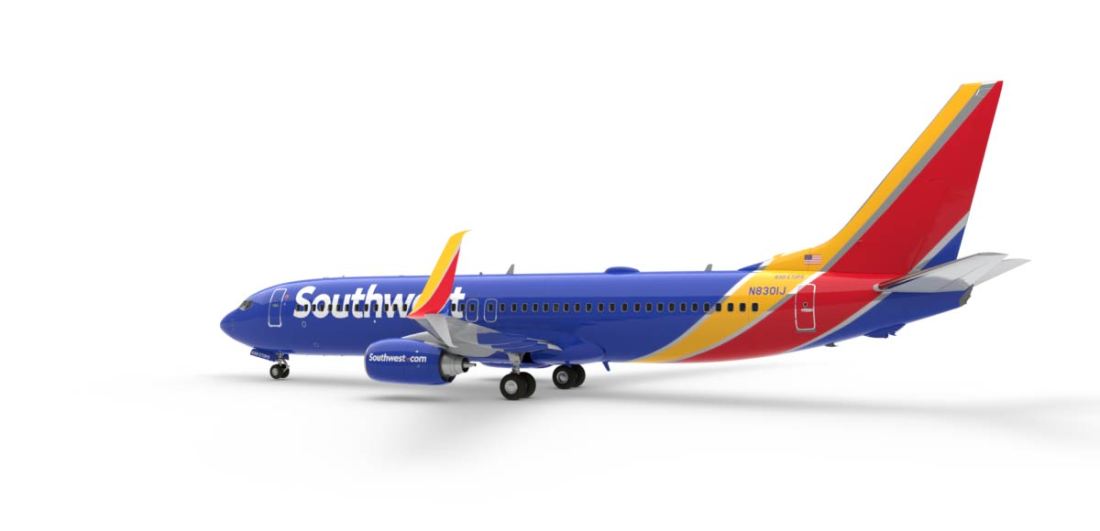 History will show that Kelleher and the Southwest founders unearthed a goldmine in short-haul flying in the United States. It is a genuine niche that others had ignored for too long. Moreover, Southwest exploited the consumers’ desire for low fares and developed a widely acceptable, no-frills style of cabin service.
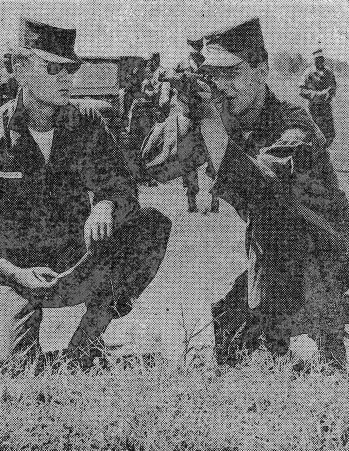 More than a half-century has passed since the day I agonized in an Army Medical Corps ambulance while a medic attended to me.
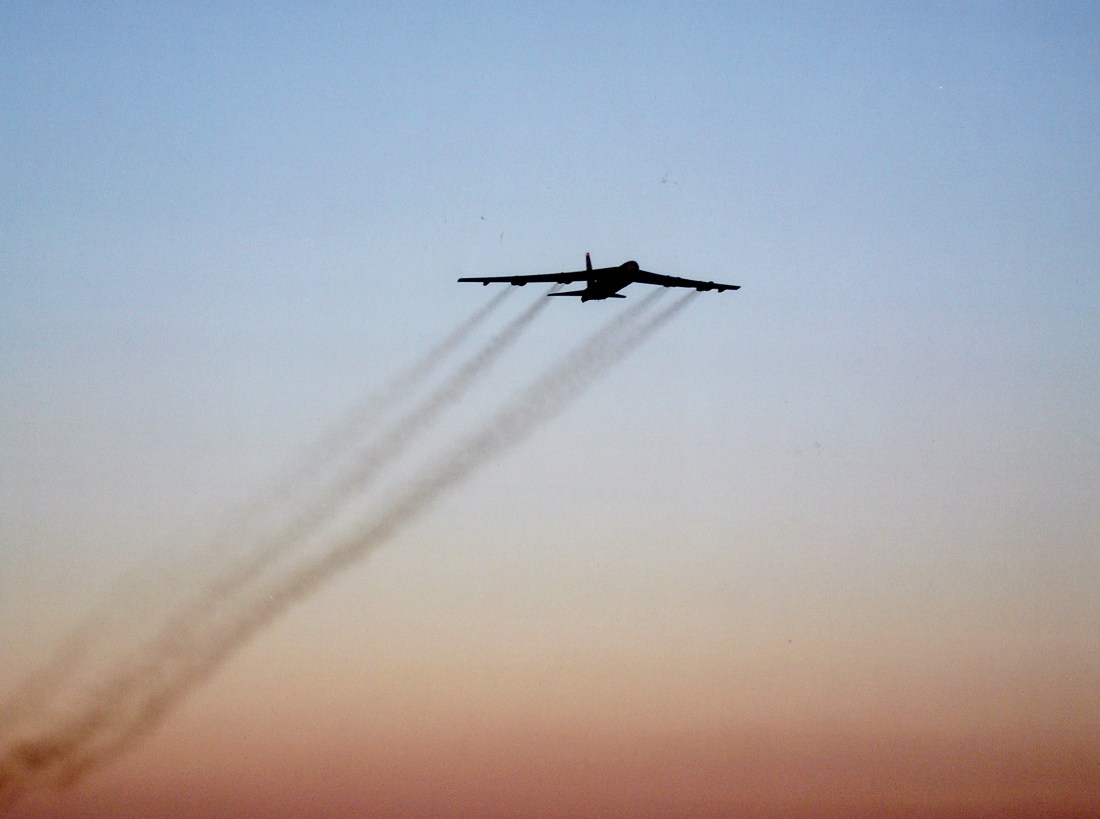 A B-52 Buffalo flies overhead at Edwards Air Force Base in the Mojave Desert burning alternative fuel from the number seven and eight engines in the far right wing pod. I took the photo in 2005 or 2006 when the Air Force was pressing hard to use alternative or bio fuels. In this case the fuel was made from gas following a process developed in South Africa and originally produced in Germany. The black stream of the Jet A is reduced from those pods.
 Ramblings on Aviation, Art and Literature